








The Seven Summits are the highest mountains of each of the seven continents. Climbing all seven is among the most respected accomplishments in mountaineering. The list varies depending on whether you follow the Bass List (Mount Kosciuszko) or the Messner List (Carstensz Pyramid) for Oceania. As of early 2026, it is estimated that fewer than 750 people have successfully completed the feat.
🏔️ Guide’s Note: The Kilimanjaro Connection
Most “Seven Summiteers” start with Mount Kilimanjaro. Because it is a non-technical “walk-up” mountain, it’s the perfect test for how your body handles high altitude before you spend thousands on Everest or Denali.
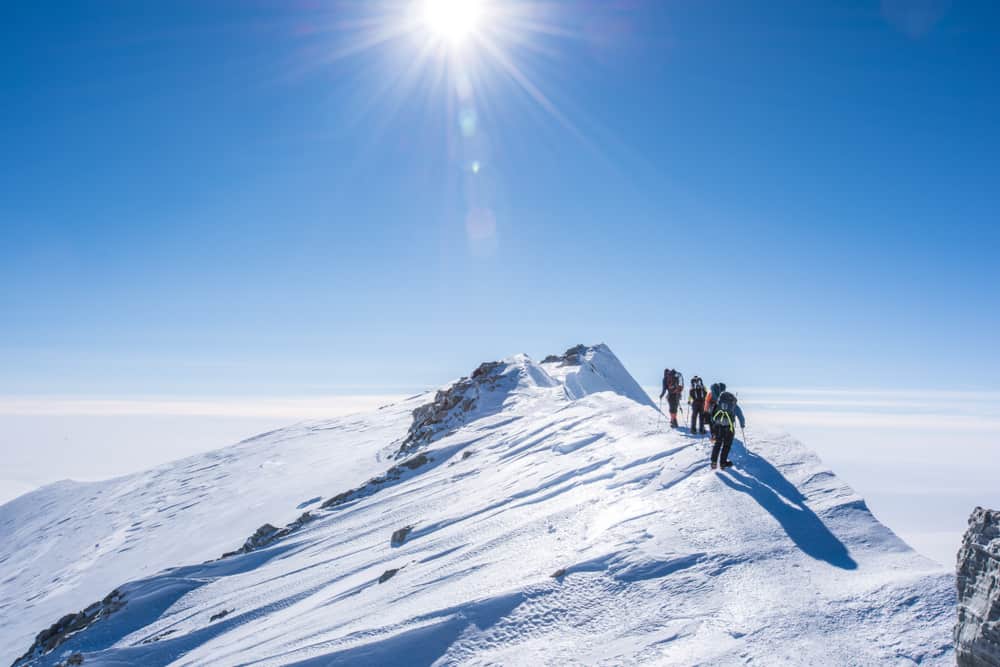
The Seven Summits Official Elevations
- Mount Everest (Asia): 29,032 ft (8,849 m)
- Aconcagua (South America): 22,837 ft (6,961 m)
- Denali (North America): 20,310 ft (6,190 m)
- Mount Kilimanjaro (Africa): 19,341 ft (5,895 m)
- Mount Elbrus (Europe): 18,510 ft (5,642 m)
- Mount Vinson (Antarctica): 16,050 ft (4,892 m)
- Mount Carstensz (Oceania): 16,024 ft (4,884 m)
Asia: Mount Everest

Mount Everest is the tallest mountain in Asia and the world. It lies in the Great Himalayas on the border between Nepal and Tibet. Reaching an elevation of 29,032 feet, it was first recognized as the highest point on Earth in 1852. While major expeditions began in the 1920s, it was not until 1953 that Edmund Hillary and Tenzing Norgay reached the summit.
South America: Mount Aconcagua

Mount Aconcagua is the highest point in both South America and the Western Hemisphere. Located in Argentina, the mountain has two summits connected by a ridge. The higher northern summit stands at 22,837 feet and was first reached in 1897 by Matthias Zurbriggen.
North America: Denali

Denali (also known as Mount McKinley) is the highest peak in North America, located in Alaska. The mountain has a summit elevation of 20,310 feet. While the first North Peak ascent was in 1910, the true South Peak summit was conquered on June 7, 1913, by Hudson Stuck and Harry Karstens.
Africa: Kilimanjaro

Mount Kilimanjaro is the highest peak in Africa, rising to 19,341 feet. Located in Tanzania, it is the tallest free-standing mountain in the world. The first recorded summit was by Hans Meyer and Ludwig Purtscheller in 1889. It was designated a UNESCO World Heritage site in 1987.
Europe: Mount Elbrus

The highest point in Europe is Mount Elbrus, located in the Caucasus range. This extinct volcano features twin cones, the tallest of which reaches 18,510 feet. It was first ascended in 1874 by a British expedition led by Peter Knubel.
Antarctica: Vinson Massif

The Vinson Massif is the highest mountain in Antarctica at 16,050 feet. Discovered in 1935, it is named for U.S. Congressman Carl Vinson. The summit was first reached in 1966 by an American expedition supported by the American Alpine Club.
Australia/Oceania: Mount Carstensz

Mount Carstensz (Jaya Peak) is the highest mountain in Oceania at 16,024 feet. Located on the island of New Guinea, it is the world’s highest island peak. The summit was first reached in 1962 by Heinrich Harrer, the famous author of Seven Years in Tibet.
Australia: Mount Kosciuszko

Mount Kosciuszko is the highest peak on the Australian continent at 7,310 feet. It is located in the Snowy Mountains of New South Wales. Paul Strzelecki was the first European to climb it in 1840, naming it after the Polish hero Tadeusz Kościuszko.
Beyond Earth: Curious about what lies beyond our planet? Read our guide to the tallest mountain in the solar system: https://ultimatekilimanjaro.com/olympus-mons-the-tallest-mountain-in-the-solar-system


