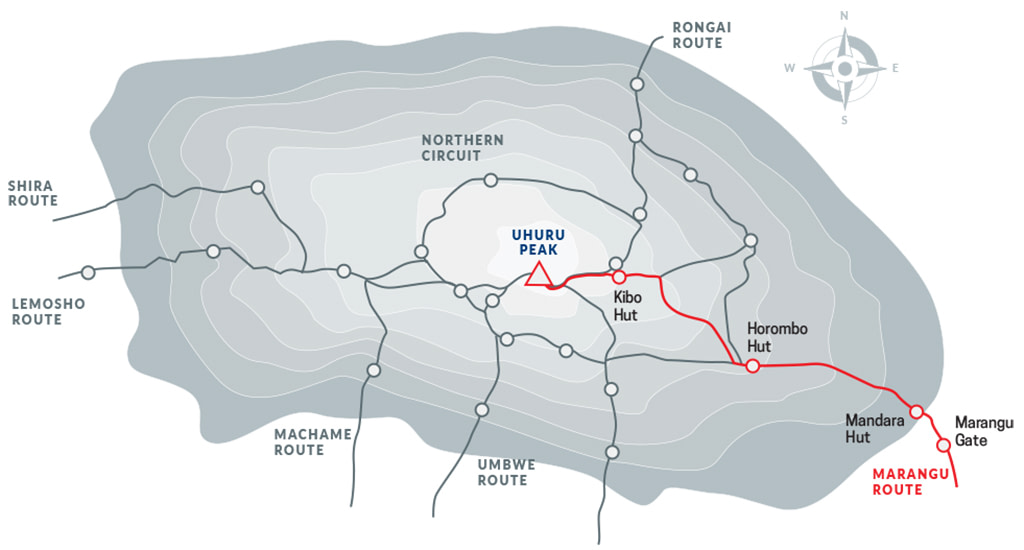
The Marangu route, also known as the “Coca-Cola” route, is the oldest, most well established route on Kilimanjaro.
This is the only route which offers sleeping huts in dormitory style accommodations in lieu of camping. There are 60 bunk beds each at Mandara and Kibo Huts, and 120 bunk beds at Horombo Hut. Guests are supplied with mattresses and pillows, but sleeping bags are still required. The huts have communal dining halls and basic washrooms, ranging from flushing toilets and running water at the lower huts to long drop toilets and buckets of water at Kibo Hut.

Many favor Marangu because it is considered to be the easiest path on the mountain, given its gradual slope and direct path. However the short time frame of the route makes altitude acclimatization fairly difficult. The route approaches Mount Kilimanjaro from the southeast. Marangu is unfortunately less scenic than the other routes because the ascent and descent are along the same path. It is also the most crowded route for that reason.

Ultimate Kilimanjaro® offers Marangu as a 5 or 6 day private climb. The 5 day variation does not have an acclimatization day on day 3 at Horombo Hut.

How Long is the Marangu Route?

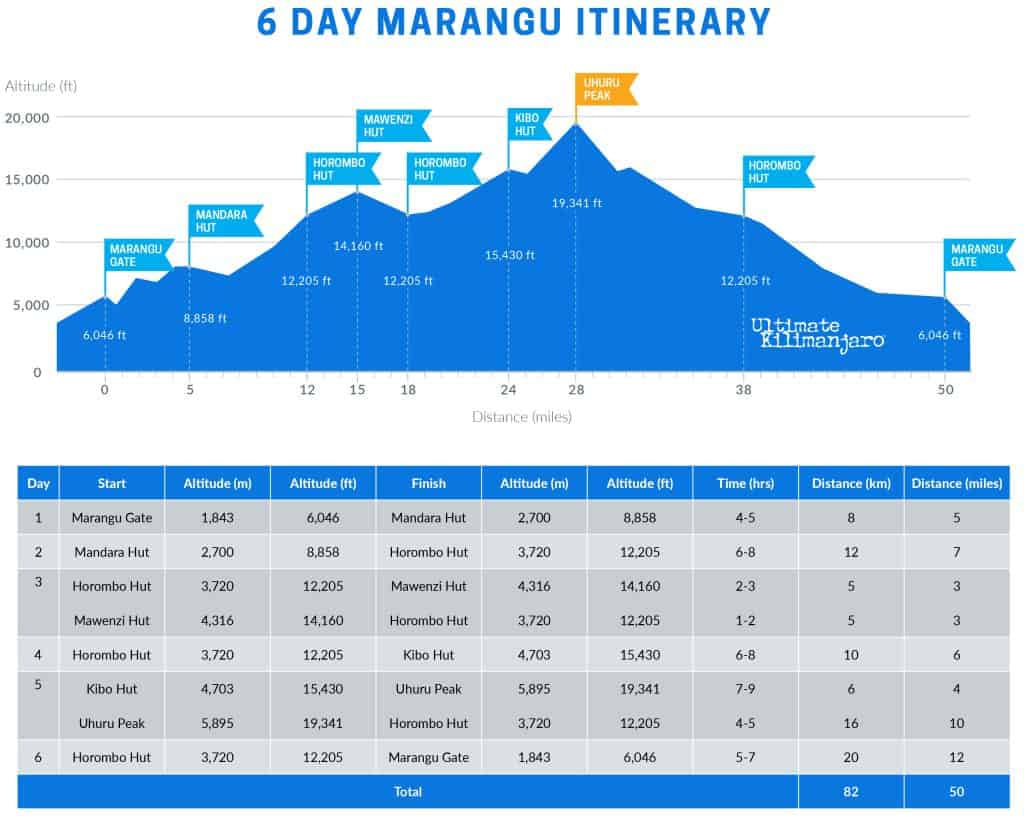
The distance of the Marangu route is approximately 82 km or 50 miles.

How Many Days Does it Take to Climb Kilimanjaro on the Marangu Route?

The Marangu route is typically done in 5 days, but the 6 day variation is significantly better.

How Hard is it to Climb Kilimanjaro on the Marangu Route?

The Marangu route is considered a hard route due of its short duration. Though the elevation gain is gradual and not strenuous, the short time spent on the mountain means climbers may have a difficult time acclimatizing.

What is the Success Rate of Climbing Kilimanjaro on the Marangu Route?

The park service last reported that the success rate of the 5 day Marangu route is only around 30% and the 6 day Marangu route is about 50%. Our Marangu success rates are consistently 15-20% higher than these figures.

How Much Does it Cost to Climb Kilimanjaro on the Marangu Route?

The cost to climb the Marangu route depends on the number of days. Our current pricing for a private climb on the 5 day Marangu route starts at $1,999 per person. See all of our prices here.


6 DAY MARANGU ITINERARY

DAY 1Marangu Gate to Mandara Hut

Elevation: 6,046 ft to 8,858 ft

Hiking Time:  4-5 hours

Distance: 8 km | 5 miles

Habitat: Rain Forest

We depart Moshi for Marangu Gate for the necessary formalities before beginning our trek. The hiking trail begins by ascending a beautiful, tropical rain forest. At the upper edge of the forest line, we have the opportunity to see blue monkeys. The trail then widens to expose beautiful hillsides until we reach Mandara Hut.

DAY 2 Mandara Hut to Horombo Hut

Elevation: 8,858 ft to 12,205 ft

Hiking Time: 6-8 hours

Distance: 12 km | 7 miles

Habitat: Heath

We start the day continuing through the forest until the trail opens into high moorland. We may get our first views of Kibo and Mawenzi peaks – two of the three volcanic peaks that make up the summit of Kilimanjaro.

DAY 3Horombo Hut to Mawenzi Ridge to Horombo Hut

Horombo Hut to Mawenzi Ridge

Elevation: 12,205 ft to 14,400 ft

Hiking Time: 2-3 hours

Mawenzi Ridge to Horombo Hut

Elevation: 14,400 ft to 12,205 ft

Hiking Time: 1-2 hours

.

Distance: 5 km | 3 miles

Habitat: Heath

.

Distance: 5 km | 3 miles

Habitat: Heath

This is an extra day meant for acclimatization and can be spent day hiking on Mawenzi Ridge. The unique landscape offers motivating views of Kibo and Mawenzi. After spending a few moments exploring the area we head back to Horombo Hut.

DAY 4 –  Horombo Hut to Kibo Hut

Elevation: 12,205 ft to 15,430 ft

Hiking Time: 6-8 hours

Distance: 10 km | 6 miles

Habitat: Alpine Desert

We climb gradually, then cross the lunar desert of the “Saddle” between Mawenzi and Kibo. Our camp, Kibo Hut, sits at the bottom of the Kibo crater wall. Once here we rest, enjoy an early dinner to prepare for the summit day.

DAY 5 –  Kibo Hut to Uhuru Peak to Horombo Hut

Kibo Hut to Uhuru Peak

Elevation: 15,430 ft to 19,341 ft

Hiking Time: 7-9 hours

Uhuru Peak to Horombo Hut

Elevation: 19,341 ft to 12,205 ft

Hiking Time: 4-6 hours

.

Distance: 6 km | 4 miles

Habitat: Arctic

.

Distance: 16 km | 10 miles

Habitat: Heath

Very early in the morning (around midnight), we begin our push to the summit. This is the most mentally and physically challenging portion of the trek. The wind and cold at this elevation and time of day can be extreme. We ascend in the darkness for several hours while taking frequent, but short, breaks. At Gilman’s point (18,600 ft), you will be rewarded with the most magnificent sunrise you are ever likely to see coming over Mawenzi Peak. Finally, we arrive at Uhuru Peak- the highest point on Mount Kilimanjaro and the continent of Africa.

After spending a few moments taking in the plains of Africa and your accomplishment, we descend to Horombo Hut. Later in the evening, we enjoy our last dinner on the mountain and a well-earned sleep.

DAY 6 – Horombo Hut to Marangu Gate

Elevation: 12,205 ft to 6,046 ft

Hiking Time: 5-7 hours

Distance: 20 km | 12 miles

Habitat: Rain Forest

On our last day, we continue the descent to Mweka Gate and collect the summit certificates. At lower elevations, it can be wet and muddy. A vehicle will meet us at Mweka Village to drive us back to the hotel in Moshi.

KILIMANJARO FAQs

How do I choose a good Kilimanjaro tour operator?

There are hundreds of companies who service the mountain, but only a handful can be considered reputable. Look for an established company with experienced and competent guides who practice high safety standards. Look for a tour operator that has proven expertise, successfully serving a wide range of clients spanning many years. Ultimate Kilimanjaro® has guided more than 15,000 clients to the summit since we began more than 18 years ago. We are the Kilimanjaro specialists. And we’re still going strong. read more>>

How much does it cost to climb Kilimanjaro?

Do not select a company strictly based on price! Price should be only one component in your overall decision. Prices vary significantly between operators, however high prices and low prices should both be viewed with caution. Ultimate Kilimanjaro® offers high quality climbs at reasonable rates. At our price levels, we can satisfy all park fees, pay real wages to staff, supply good food and equipment, while still providing great service to our clients, equal or better than climbs costing much more. read more>>

When is the best time to climb?

The best months tend to be the warmest and driest months – January, February, and September. June, July, August and October are also good months. However, temperatures and weather are unpredictable, and can change drastically based on the time of day and altitude. For most people, it’s best to avoid the long rainy season, from the end of March to early June, and the short rainy season, from November through the beginning of December. read more>>

Which is the best route for climbing Kilimanjaro?

Each route has different characteristics that may or may not appeal to you. Consider the difficulty, scenery and crowds when you select your route. Other factors that should be considered are your age, fitness level, medical conditions, backpacking and hiking experience, experience at high altitude, degree of motivation, and any other special considerations. Ultimate Kilimanjaro® recommends the Northern Circuit, Lemosho, Machame and Rongai routes. Which is best depends on your specific situation. read more>>

How long does it take?

The more days that you spend on the mountain, the higher your chances of reaching the summit. Statistics show that each additional day you spend acclimatizing increases your probability of success. Therefore we strongly recommend that you do not book the minimum number of days. Odds are you will experience altitude sickness, won’t enjoy your hike, and won’t reach the top. Seven or more days is highly recommended for a safe and successful climb. Our 8 and 9 day routes are the most popular. read more>>

What is the weather like on Kilimanjaro?

Mount Kilimanjaro does not experience wide temperature changes from season to season. Instead, the temperatures are determined more so by the altitude and time of day. The trek from base to summit crosses several distinct climate zones, each with different temperatures, humidity, and precipitation levels. On the lower slopes, the average temperature is around 70 to 80F (21 to 27C) and decreases as you gain elevation. At the top, night time temperatures can range between 20 to -20F (-7 to -29C). read more>>

What gear do I need?

You are responsible for bringing personal gear and equipment while communal equipment (tents, food, cooking items, etc.) is provided. Our comprehensive gear list contains everything you need to tackle the mountain’s varied terrain and weather. It includes technical clothing such as a waterproof jacket, insulated jacket and base layers as well as equipment such as a backpack and sleeping bag. Note that you will only carry a small daypack with you while you hike between camps. The remainder of your gear is transported by our support crew. No need to carry heavy packs! read more>>

How do I train to climb Kilimanjaro?

It is very hard to gauge the mental and physical strength needed for tackling the peak. If you’ve spoken to those who have successfully or unsuccessfully climbed it, you’d get a wide range of accounts. The truth is, like any other activity, some people excel at it and some people struggle. We recommend a minimum of two months of physical training – more if you are out of shape, less if you are already an avid hiker. The best exercise is doing day hikes for four to six hours, with moderate elevation changes (~1,500 ft), while carrying a 20 lb. pack. Endurance is key, so focus on long sessions at a slow pace. read more>>

Is climbing Kilimanjaro dangerous?

Ultimate Kilimanjaro® has robust safety systems in place to minimize the dangers of high altitude trekking. Our guides are certified Wilderness First Responders. We perform health checks twice per day to monitor oxygen saturation levels and pulse rate. Additionally the Lake Louise Scoring System helps us determine whether climbers have altitude sickness and if so, its severity. Bottled oxygen is carried on every climb as a precaution and added safety measure. We can even initiate helicopter rescue if necessary. Your health and well being is our first priority and we take that responsibility very seriously. read more>>

Why are some company’s prices so low?

There is a fair share of budget tour operators who offer cheap climbs. These poorly run companies use low prices as their only way to attract clients. There is simply no way for these tour operators to provide satisfactory services without skimping on necessary expenditures that affect the quality of your climb. For starters, they have low level guides (top guides don’t work for budget companies), questionable equipment, and serve nutrient deficient meals. Furthermore, they engage in appalling practices such as paying paltry wages, underfeeding staff, and forcing porters to carry loads greater than the weight limit. Never climb with a budget operator. read more>>

All transfers

Includes airport pickup and drop-off plus all hotel–trailhead transfers required for your itinerary. Our logistics team coordinates timing and vehicles for a smooth start and finish.

Hotel before and after the hike

One night before the climb and one night after descent in Moshi-area 3★ lodging (double occupancy by default; single supplement available). Typical options include Aishi Machame (quiet, rural) or Brubru Lodge (closer to cafés/shops). Breakfast included; à la carte lunch/dinner available. Orientation briefing at your hotel; extra nights charged if you descend early.

Camping equipment

Durable 4-season tents (2 people per tent), optional private tent upgrade, 3″ sleeping mats, spacious dining tents, stainless/ceramic tableware (no disposables), comfortable camp chairs, and a hot-water handwashing station. Camp managers secure scenic, uncrowded spots and maintain equipment.

Meals on the hike

Breakfast, lunch, and dinner prepared by mountain chefs with dietitian-informed menus. Vegetarian, vegan, gluten-free, lactose-free, and other plans at no extra cost. Fresh local ingredients; Day-1 lunch packed in compostable containers. Note: mountain conditions can affect presentation, but quality remains a priority.

Professional guides and porters

Experienced, WFR-certified guides with deep Kilimanjaro knowledge lead your trek, supported by porters, camp managers, and chefs. Ethical treatment, KPAP membership, and consistently top-rated service, balancing great storytelling with respect for quiet time.

Oxygen tanks

Bottled oxygen carried on every expedition and used proactively to ease acclimatization and to address early AMS symptoms. Large, centrally managed stock ensures availability and rapid resupply when needed.

GPS trackers

Reliable GPS devices provide real-time team tracking. You receive a QR code link on departure morning, also available in your Personal Trip Board to share with family and friends.

Medical check-ups & in-company doctor

Mandatory twice-daily health checks (SpO₂, pulse, and when needed BP/lung sounds) enable early AMS detection using the Lake Louise system. Pre-departure forms reviewed by our company doctor; protocols in place for common conditions (e.g., diabetes, asthma). Medical records are kept confidential.

24/7 support via satellite phone

Guides carry a satellite phone for emergency contact with base when mobile service is unavailable, ensuring immediate assistance. Personal satellite units can be rented for private calls if desired.

Fully-loaded medical kits

Comprehensive camp medical kits (≈49 medication types/items) plus guide tactical kits for on-trail needs. In rare hospitalizations, clients receive expedited care at KCMC with a reserved ward, Wi-Fi, meal support, and a dedicated company manager.

All park fees and taxes

All mandatory park payments are covered (camping, conservation, rescue, crew, forest fees, etc.). We also pay all applicable Tanzanian taxes and levies, contributing significantly to local communities.

Dedicated support team

200+ specialists across reservations, transfers, expeditions, customer experience, logistics, hotels, warehouse, and transport coordinate every detail. Your travel consultant is reachable 24/7 across time zones.

Innovative travel planning portal

Personal Trip Board centralizes your itinerary, forms, payments, waivers, gear list, and trip updates—keeping planning simple and transparent.

Safe room and storage room

Free storage for non-essentials; valuables secured in a monitored, reinforced safe room with strict logging and receipts. Cash generally isn’t needed on the mountain; souvenirs are best purchased after the trek.

Leave No Trace adventure

Dedicated “clean mountain” crew ensures our teams leave no waste and collect litter left by others. We minimize plastics; Day-1 lunch packaging is compostable (Vegware).